
 August 5, 2026
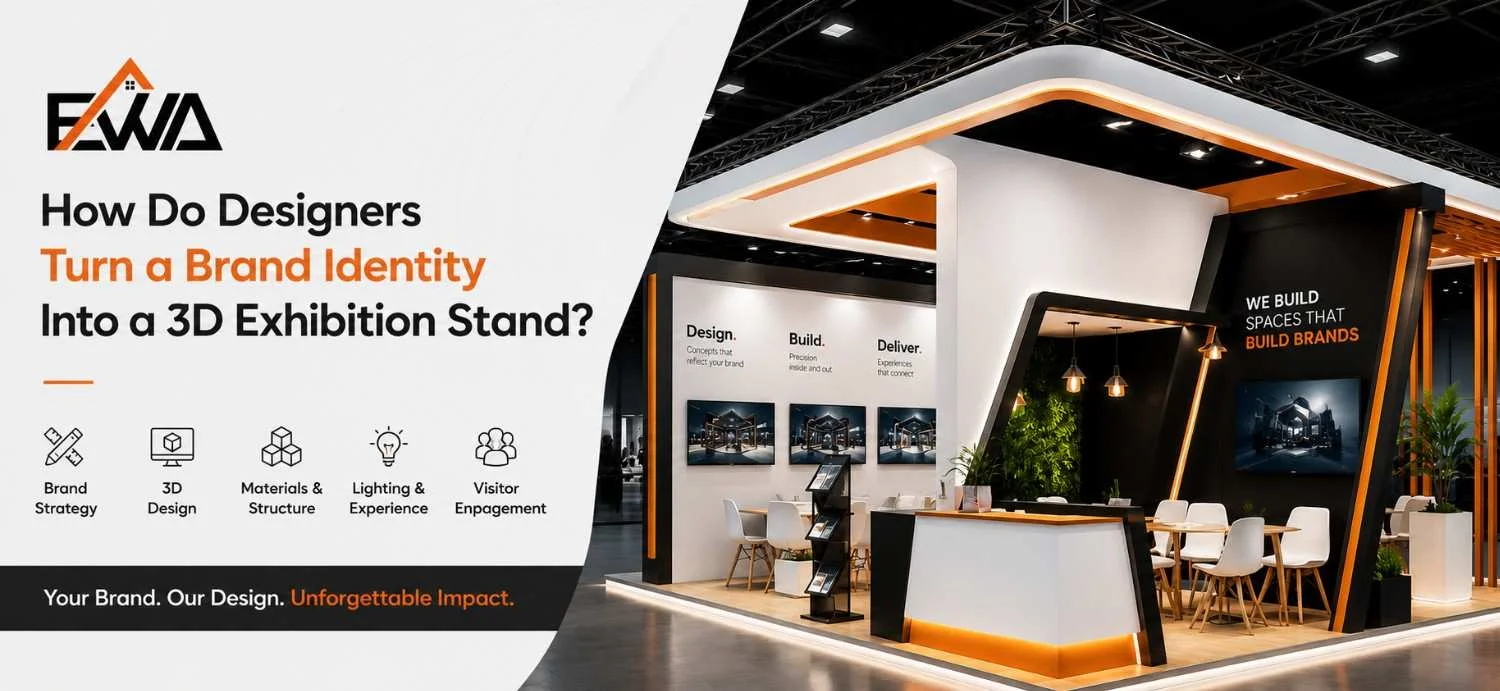
Designers translate a brand identity into a 3D exhibition stand by breaking it into visual building blocks – colour, material, shape, tone – then rebuilding those blocks as physical structure and spatial flow. It’s less about pasting a logo onto a wall and more about asking what that logo would feel like if you could walk through it. That’s why bespoke exhibition stand builders spend nearly as much time on brand strategy calls as they do inside 3D software.
What Does “Brand Identity” Actually Mean on a Show Floor?
A brand identity on paper is a logo, a colour palette, a tone of voice. On a show floor, none of that means muchunless people can see it clearly from thirty feet away, under harsh lighting, beside a dozen competing booths. So the first job of any designer is translation – turning a flat brand guideline into something that reads instantly in three dimensions.
A lot of bespoke exhibition stands go wrong right here. A company hands over its brand book expecting the flat visuals to simply get “built,” and what comes out feels stiff, like a slide deck propped up on scaffolding. Good design treats the brand book as a reference point, not a blueprint to copy literally.
Why Do Designers Start With Questions Instead of Sketches?
Before any sketch happens, there’s usually a discovery conversation – what should visitors feel, who’s walking the aisle, what’s the budget. Skip this stage and you often end up with a stand that looks fine in a render but says nothing about the company behind it. Experienced bespoke exhibition stand builders treat discovery as non-negotiable.
A few things typically get mapped out early:
- Core brand colours, since they shift dramatically under hall lighting versus a guideline PDF
- Tone – a playful startup and a serious industrial supplier shouldn’t look alike
- Visitor flow – where people enter, pause, and exit
- Practical limits like hall height, budget, and reusability across future shows
Once these answers exist, the design has something real to push against instead of guesswork.
How Does a 2D Logo Become a 3D Structure?
This is the technical heart of it. A logo’s angle or negative space often becomes structural inspiration – a sharp diagonal might turn into an angled canopy, a rounded icon into curved walls. Colour gets assigned to specific zones instead of splashed everywhere, so the eye reads the space as deliberate rather than busy.
Materials carry equal weight. A skincare brand and a heavy machinery manufacturer shouldn’t share a finish – one wants soft matte panelling, the other exposed metal and bold graphics. This is where an experienced bespoke exhibition stand contractor earns their fee, since the gap between a slick render and a buildable stand is wider than most people expect. Ideas that look effortless on screen sometimes can’t clear hall regulations, and catching that early saves money and panic later.
What Role Does Lighting and Layout Play in Brand Storytelling?
Lighting is one of the most underrated tools in the process. The same structure can feel cold and clinical or warm and premium purely based on how it’s lit. Designers use light to guide eyes toward key products and reinforce brand colour without repainting a wall – a subtlety bespoke exhibition stand builders tend to obsess over far more than clients expect.
Layout tells its own story too. A brand built around openness might get a stand with no front wall at all, inviting people straight in. One focused on exclusivity might use partial enclosures or a raised platform instead. None of this is decoration – it’s brand strategy expressed as a floor plan.
How Long Does This Process Usually Take?
For a mid-sized custom stand, the journey from first sketch to finished structure typically runs 8 to 12 weeks, factoring in revisions, sourcing, fabrication, and installation. Complex double-decker or pavilion builds stretch well beyond that, which is why serious bespoke exhibition stands need planning to start months, not weeks, ahead of a show date.
Why Does This Process Matter More Than People Assume?
A generic-looking stand doesn’t just fail to impress – it costs the brand attention it paid good money to earn. Visitors form an opinion within seconds of glancing at a booth, long before any conversation happens. That first impression is brand identity doing its job, or quietly failing to. This is where a capable bespoke exhibition stand contractor proves its worth, turning a split-second impression into something deliberate.
This is really the argument for hiring specialists over treating a stand as a one-off carpentry job. The strongest bespoke exhibition stand builders aren’t just assembling walls and counters – they’re carrying a visual language into a walkable space that has to hold up under real scrutiny: bright lights, tired feet, thirty seconds of a stranger’s attention.
At Ewa Exhibition, this translation process sits at the centre of how every stand comes together – from the first discovery call through in-house fabrication. Ewa Exhibition’s teams across Europe, the US, and Asia apply this same approach show after show, which is largely why Ewa Exhibition keeps hearing from returning clients.
Thinking about your next show? Get in touch with Ewa Exhibition and let’s turn your brand into a stand people actually remember.


